When a Car Goes Around a Banked Circular Curve
F c mv 2 r w sin cos F c mv 2 r w tan. The angle of banking is given by the formula as.
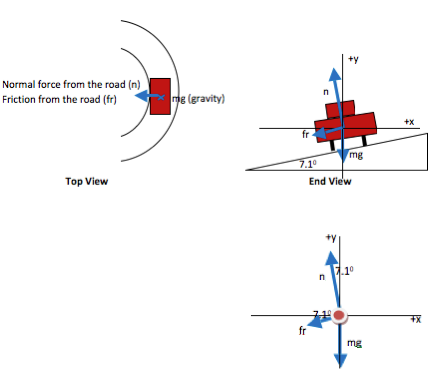
Circular Motion Force Problem Banked Curve Physics University Of Wisconsin Green Bay
Consider a circular curve of radius R 200 m and bank angle theta.
. If there is no friction there is no force that can supply the centripetal force required to make the car move in a circular path - there is no way that the car can turn. What is the maximum speed with which a 1400 kg rubber-tired car can take this curve without sliding. What is the radius of the curve.
A car of mass m goes around a banked curve of radius r with speed v. Since friction comes and goes with the weather and tire condition we want to design a road so. The roadway is banked so that a vehicle can go around the curve with the.
When a car goes around a banked circular curve at the proper speed speed for the banking angle what force cause it to follow the circular path. The centripetal force is given by F_centmamv2r We have values for the velocity and the radius so. The curve is banked 71 o from the horizontal and is rated at 35 mph.
A curved section of the roadway is a circular arc of 760 m radius. A car goes around a curve on a road that is banked at an angle of 315. A concrete highway curve of radius 800 m is banked at a 130 degree angle.
This gives the angle necessary for a banked curve that will allow a car to travel in a curve of radius r with constant speed v and require no friction force. If the road is frictionless due to ice the car can still negotiate the curve if the horizontal component of the normal force on the car from the road is equal in magnitude to. Fmax r Fy 0.
Suppose we consider a particular car going around a particularbanked turn. For a banked curve withfriction a frictional force acts on a fast car to oppose the tendencyto slide out of the curve. V videal.
If the road is flat that force is supplied by friction. Even if there was no friction between your car tires and the road if you went around the curve at this design speed you would be fine. Tan v 2 g r.
The roadway is banked so that a vehicle can go around the curve with the. Take the static coefficient of friction of rubber on concrete to be 10 Homework Equations tex F_r fracmv2rtex texF_f mu Ntex The Attempt at a. A the friction force from the roadb gravityc the normal force from the road.
Banking angle at the curved turns of the roads reduces friction between the tires and the road and this in turn reduces maintenance cost and accidents of the vehicles. Cars on banked turns. You are making a circular turn in your car on a horizontal road when you hit a big patch of ice causing the force of friction between the tires and the road to become zero.
The car takes the turn at 52 mph 23 ms. Banking angle is θ and the center of the circle is at C. Click card to see definition.
The centripetal force neededto turn the carmv2r depends on the speed of the car since the mass ofthe car and the radius of the turn are fixed - more speed requiresmore centripetal force less speed requires less centripetal force. F_centmxx14250392m N The frictional force must be equal to or greater than this force in order for the car to successfully make it. M v 2 r m g tan.
If a car goes through a curve toofast the car tends to slide out of the curve. A car goes around a curve on a road that is banked at an angle of 35 degrees. The centripetal force availableto turn the car.
Sections 53 - 55. A banked curve is designed for one specific speed. Determine the motion in each direction using Newtons 2nd law and the force diagram.
The radius of the curve is 210 m. The force is directed down the bank in thedirection water would drain. Find the maximum speed a car of mass m traveling along a banked curve whose path is the shape of a circle of radius r can have in order to make the curve without sliding up the incline.
When a car goes around a curve there must be a net force toward the center of the circle of which the curve is an arc. The normal force from the road b. No force causes the car to do this because the car is traveling at constant speed and therefore has no acceleration.
A A car travels on a circle of radius r on a frictionless banked road. A car rounds a banked curve where the radius of curvature of the road is R100m the banking angle 10 degrees and the coefficient of static friction is 10 slippery conditions. So the radius of curve is 7709 meters.
A car is rounding a circular curve of radius r on a banked turn. Even though the road is slick the car will stay on the road without any friction between its tires and the road when its speed is 227 ms. A roadway for stunt drivers is designed for race cars moving at a speed of 95 ms.
The friction force from the road c. On the other hand if the car is on a banked turn the normal force which is always perpendicular to the roads surface is no longer vertical. A 540 kg car is merging onto the interstate on a banked curve.
A curved section of the roadway is a circular arc of 760 m radius. Cars Traveling Around a Banked Curve w friction Ex. While the car is on the ice it.
Tap card to see definition. Physics questions and answers. The radius of curve is 7709 meters.
What sideways frictional force is required between the car and the road in order for the car to stay in its lane. When a car goes around a banked circular curve at the proper speed for the banking angle what force cause it to follow the circular path. Speed of the car v 23 ms.
A good example of uniform circular motion is a car going around a banked turn such as on a highway off-ramp. These off-ramps often have the recommended speed posted.

Forces And Circular Motion Banked Curves Circular Motion Circular Motion
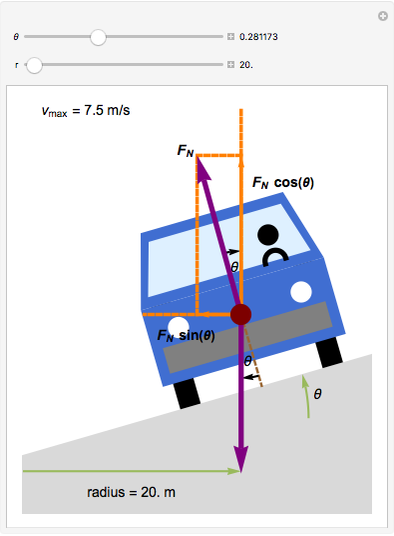
Car On A Banked Road Wolfram Demonstrations Project
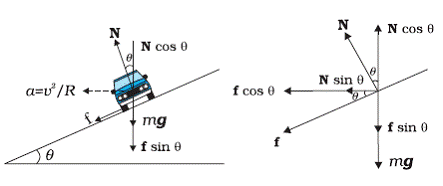
Draw The Free Body Diagram Of A Car On A Banked Road And Explain Which Two Component Of Force Provides The Necessary Centripetal Force To Move In Circ Physics Topperlearning Com

Comments
Post a Comment